Most home service businesses think they have a handle on customer feedback because they collect reviews.
They don't.
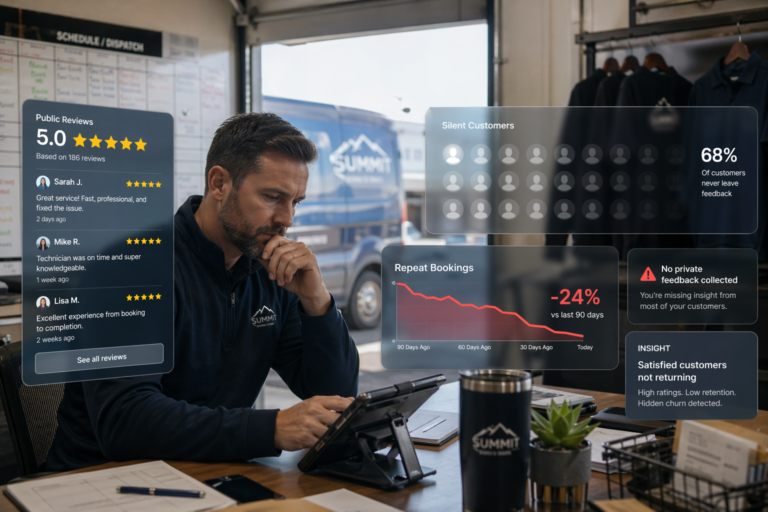
Reviews are public, reviews are quick, and reviews only capture a quick snapshot from customers who aren't shy. The rest of your customers, the ones who had a fine experience, a mediocre experience, or a quietly frustrating one, disappear into silence and take their repeat business with them.
If your only feedback system is your Google profile, you are making a mistake that is costing you repeat jobs right now. And the worst part is that nothing in your business is telling you it's happening.
The Mistake Most Home Service Businesses Make With Feedback
The mistake is treating reviews as a feedback system.
Reviews are a reputation tool. They exist to influence prospects who are evaluating your business before they've ever worked with you. They serve that purpose well. But they were never designed to help you understand what your existing customers actually think about the experience they're having with your business over time.
Confusing reputation management with customer feedback leaves enormous blind spots in how you understand your own operation. You end up optimizing for the public perception of your business while having almost no real visibility into the private reality of it.
Those are two very different things. And running a business as if they're the same is how repeat jobs quietly slip away without anyone noticing until the revenue dip is already underway.
What Real Customer Feedback Actually Tells You
Here's the difference that matters.
Reviews tell you how customers want to be perceived publicly. Surveys tell you how customers actually feel privately. And the gap in honesty between those two channels is more significant than most business owners realize.
A customer who gives you four stars on Google and writes a polite two-sentence review might tell a private survey that they had three real concerns about the visit that they didn't want to air publicly. Maybe they felt the technician was rushed. Maybe something was left not quite right and they didn't want to make a big deal out of it. Maybe communication before the job was confusing and they weren't sure what to expect.
None of that shows up in the four-star review. But all of it influences whether they book again.
That gap between what customers say publicly and what they actually feel privately is where the most valuable information in your business lives. And the only way to access it is to ask in a channel where customers feel comfortable being honest.
Why the Timing of Feedback Collection Matters
Even when businesses do try to collect feedback, many of them get the timing wrong and it undermines the entire effort.
Feedback collected days or weeks after a job is less accurate, less actionable, and far less likely to be completed. The customer has moved on. The details of the experience have blurred. The specific frustration that would have been easy to articulate the same afternoon has faded into a general impression that's much harder to do anything useful with.
The window for capturing genuine customer sentiment is short. It opens right after the job is completed, when the experience is still vivid and the customer's feelings about it are still close to the surface. Miss that window and the feedback you eventually collect is filtered through time, mood, and memory in ways that strip out the specific, actionable details that actually help you improve.
Timing isn't a minor detail in feedback collection. It's most of what determines whether the feedback you get is useful or not.
The Repeat Job Problem
Home service businesses that rely heavily on repeat work from existing customers are especially exposed to this mistake. And that's most of them.
Lawn care. Home cleaning. Pest control. HVAC maintenance. Carpet cleaning. These are businesses where the customer relationship doesn't end after the first visit. It's supposed to keep going. And the health of that ongoing relationship depends entirely on how well the business understands the customer's experience between jobs.
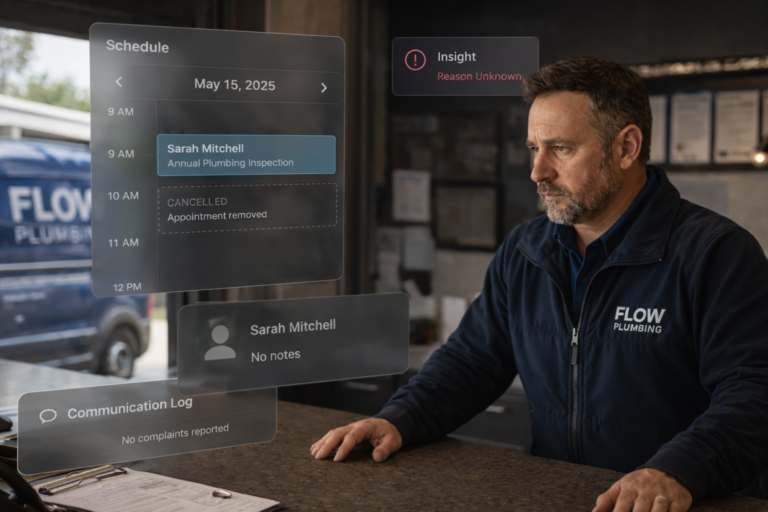
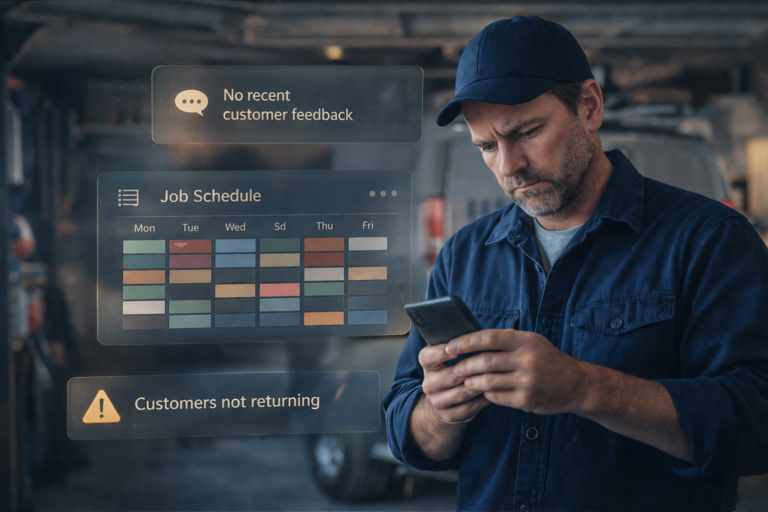
When you don't have a real feedback system, you have no early warning that a customer's satisfaction is slipping. There's no flag, no alert, no signal of any kind. The dispatch board stays full. The route looks complete. And a customer who has been on your schedule for eighteen months is quietly deciding not to rebook without ever telling you why.
By the time the repeat job doesn't come, it's too late to understand what happened or do anything about it. The opportunity to fix the issue, retain the customer, and protect that recurring revenue is gone. And it was gone weeks before the cancellation ever showed up in your system.
What Fixing This Mistake Actually Looks Like
The fix isn't complicated. But it does require treating feedback as its own system rather than a byproduct of your review collection process.
A structured, automated feedback system captures customer sentiment privately, immediately after every completed job, and ties each response back to the specific job, technician, and service type involved. Not a one-time survey push when something goes wrong. Not a quarterly check-in that most customers ignore. A continuous loop that runs automatically in the background and surfaces issues in real time so the business can act before the repeat job is lost.
When the system works correctly, a customer who had a frustrating experience gets a private, low-pressure opportunity to share it within hours of the job being completed. The right person on your team gets notified. A response goes out. The issue gets addressed. And a customer who was quietly preparing to find someone else gets a reason to stay.
That's the difference between a business that reacts to churn and a business that prevents it.
The Compounding Benefit of Getting This Right
Businesses that build genuine feedback systems don't just retain more customers. They improve faster across the entire operation.
They spot patterns earlier. A technician who consistently generates mediocre feedback shows up in the data long before the complaints become public. A service offering that customers frequently flag as inconsistent gets identified before it starts damaging the overall reputation. A scheduling or communication issue that's frustrating customers across multiple routes becomes visible and fixable before it turns into a wave of cancellations.
They coach technicians more effectively because the feedback is tied to specific jobs and specific people, not just general impressions. They make better decisions about which services to invest in and which to rethink. They understand their customer base with a level of depth that businesses running on reviews alone simply never develop.
The feedback stops being a customer service exercise and starts being operational fuel. It shapes how the business grows, how the team develops, and how decisions get made at every level.
That kind of clarity compounds over time in ways that are hard to quantify but impossible to miss once you have it.
Start Capturing the Feedback That Actually Moves Your Business Forward
Chatavise Survey Suite turns post-job feedback into a continuous, automated, and actionable loop without adding any work to your office team. It integrates directly with your field service system so every completed job triggers a survey via SMS, ties the response back to the right customer, job, and technician, and gets the right information to the right people immediately.
No manual effort. No missed windows. No repeat jobs lost to problems you never knew existed.
Schedule a demo today and see what a real feedback system looks like for your home service business.