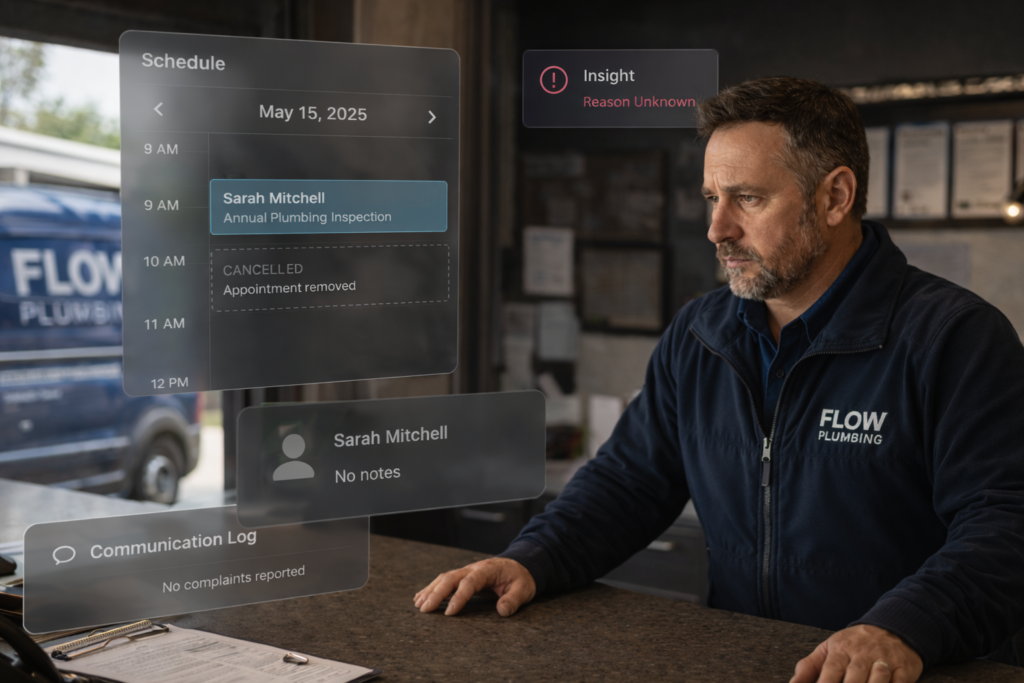
In most home service businesses, cancellations feel like they come out of nowhere.
One day the customer is on your schedule. The next day they're not. No complaint beforehand. No warning call. No email asking to speak with someone about a problem. Just silence, and then gone.
If you've been running a home service business for any length of time, you know exactly what this feels like. And if you're being honest, you probably can't tell me why most of those customers left.
That's not a management failure. It's a systems failure. And it's one that most home service businesses don't even realize they have.
Why Unhappy Customers Don't Speak Up
Complaining takes effort. It requires the customer to articulate what went wrong, find the right person to tell, and then go through the uncomfortable process of raising an issue with a business they've already let into their home.
Most people won't do it. Not because they don't care, but because it's easier to just find someone else. The friction of complaining almost always outweighs the potential benefit, especially when there are three other lawn care companies running routes in the same neighborhood or two other cleaning services their neighbor already uses.
The path of least resistance for a dissatisfied home service customer is not to complain. It's to quietly stop scheduling.
And that's exactly what they do.
The Types of Businesses Most Exposed to Silent Churn
Not every home service business carries the same level of risk here. A one-time junk removal job has a clear endpoint. The customer either books again or they don't, and the stakes of any single interaction are relatively contained.
Recurring service businesses are a different story entirely.
Lawn care. Pest control. HVAC maintenance agreements. Home cleaning. Carpet cleaning. These are businesses where the customer has multiple opportunities, across multiple visits and multiple months, to quietly decide that the relationship isn't working anymore. One bad visit. One miscommunication about a schedule change. One new crew member who didn't quite meet the standard the customer had come to expect. Any one of these can start a countdown that ends in cancellation weeks later, long after the original issue has been forgotten by everyone on your team.
The longer the customer relationship, the more invisible the erosion can be. A customer who has been with you for two years doesn't cancel after one bad experience. They give it another visit. Then another. They tell themselves it was a one-time thing. But if the issue doesn't get addressed because nobody knew it existed, the patience runs out eventually. And by then, the reason is so buried that even the customer might struggle to articulate it clearly.
What Silent Churn Actually Looks Like From the Inside
This is the part that makes silent churn so dangerous for growing home service businesses. It doesn't look like anything, at least not at first.
Your dispatch board is full. Your crews are moving. Revenue looks steady. Nothing in your field service software is throwing a flag. From every operational dashboard you have access to, the business looks healthy.
But underneath the surface, a small percentage of your customer base is making their decision every single week. The customer on Tuesday's route who got a different crew without any notice. The customer who texted in with a question last month and never heard back. The customer who had a minor issue after a service visit and mentioned it once, casually, and then never brought it up again because nothing changed.
Each one of them is in a different stage of the same quiet process. And by the time the cancellations start showing up as a noticeable pattern in your numbers, most of those customers are already gone. The reasons went with them.
The Only Way to Hear What Customers Won't Say Out Loud
You cannot fix what you don't know about. That sounds obvious. But the implication is more significant than most business owners stop to consider.
If your only feedback channel is public reviews, you are only hearing from two kinds of customers. The ones who were delighted enough to go out of their way to say something positive. And the ones who were angry enough to go out of their way to warn others. The vast middle, the quietly satisfied, the mildly disappointed, the nearly-churned, stays completely silent.
The only way to surface that silent dissatisfaction before it becomes a cancellation is to create a structured, low-pressure moment for the customer to share how things are actually going. Not a public review request. A private conversation. One that happens automatically, at the right time after every service visit, and feels simple enough that the customer actually responds.
That's what a post-job survey does when it's built and delivered correctly. It doesn't ask the customer to perform satisfaction for the public. It asks them privately how things went. And because the ask is low-stakes and lands via SMS in the same channel they've been communicating with you all day, the barrier to responding is low enough that customers who would never leave a review will still answer a quick question about their experience.
What Happens When You Catch It Early
A customer who is losing confidence in your service is not necessarily a lost customer. That's the part most business owners miss because by the time they find out there was a problem, it's already too late to do anything about it.
When you catch dissatisfaction early, while the customer is still on your schedule and still giving you the benefit of the doubt, you have a genuine opportunity to turn the situation around. A fast response from the right person, an acknowledgment that the issue was heard, and a concrete step toward making it right can transform a near-cancellation into one of the most loyal customers you have.
This isn't a theory. It's a pattern that shows up consistently in businesses that run active feedback loops. The customer who almost left but felt genuinely heard often becomes a stronger advocate for your business than the customer who never had a problem at all. Because now they know what you're made of when things don't go perfectly.
That recovery moment is only possible if you knew the problem existed. And the only way to know is to ask.
What This Looks Like in Practice
An automated SMS survey sent shortly after every completed job creates a continuous feedback loop that runs quietly in the background without adding any work to your office team.
When a response signals a problem, the right people get notified immediately. Not tomorrow. Not when someone happens to check the dashboard. Right now, while there is still time to respond before the customer makes their decision.
When a response is positive, it can automatically trigger a review request, a follow-up message that deepens the relationship, or a tag that tells your team this customer might be open to learning about additional services you offer.
The customer who was three weeks away from canceling without a word now has a private channel to share how they actually feel. And you have the information you need to act before it's too late.
That's not just a survey. That's a retention system.
Stop Losing Customers You Never Knew Were Leaving
Chatavise Survey Suite was built specifically for home service businesses that need a continuous, automated feedback loop without adding work to their office team. It integrates directly with your field service system so every completed job can trigger a survey via SMS, tie the response back to the right customer and technician, and alert the right people the moment something needs attention.
No manual effort. No spreadsheets. No cancellations that come out of nowhere.
Schedule a demo today and start hearing what your customers have been trying to tell you.